Mansion shortage in Florida reveals opportunity in real estate development
The scarcity in the luxury market is not a problem — it is a clear signal of where the opportunity lies.
You’ve seen the numbers: record sales, rising prices, strong demand. At first glance, it looks like the ideal scenario. But there is a silent distortion that completely changes the interpretation. Even with historic volumes of capital flowing into Florida’s real estate market, there is a shortage of product — especially at the top end. And this is the central point most people overlook: the profit is not in the appreciation of what already exists, but in the creation of what has not yet been delivered.
Florida is no longer just an attractive destination — it has evolved into a global hub for real estate capital. The inflow of high-net-worth individuals, particularly from California and major financial centers, is not temporary — it is structural. It is supported by consistent factors such as tax efficiency, asset protection, quality of life, and legal predictability. This type of capital does not operate with a short-term mindset. It seeks preservation, positioning, and scarce assets.
The issue is that the market has not kept up.
The structural imbalance few are pricing in
What exists today is not just a heated market — it is a misaligned one. Demand for high-end properties has grown at a much faster pace than the market’s ability to replenish inventory. Well-located land is limited, approval processes are slow, and there are physical and regulatory constraints that prevent a rapid expansion of supply.
This type of imbalance leads to a predictable outcome: supply compression in premium assets.
And when that happens, buyer behavior changes.
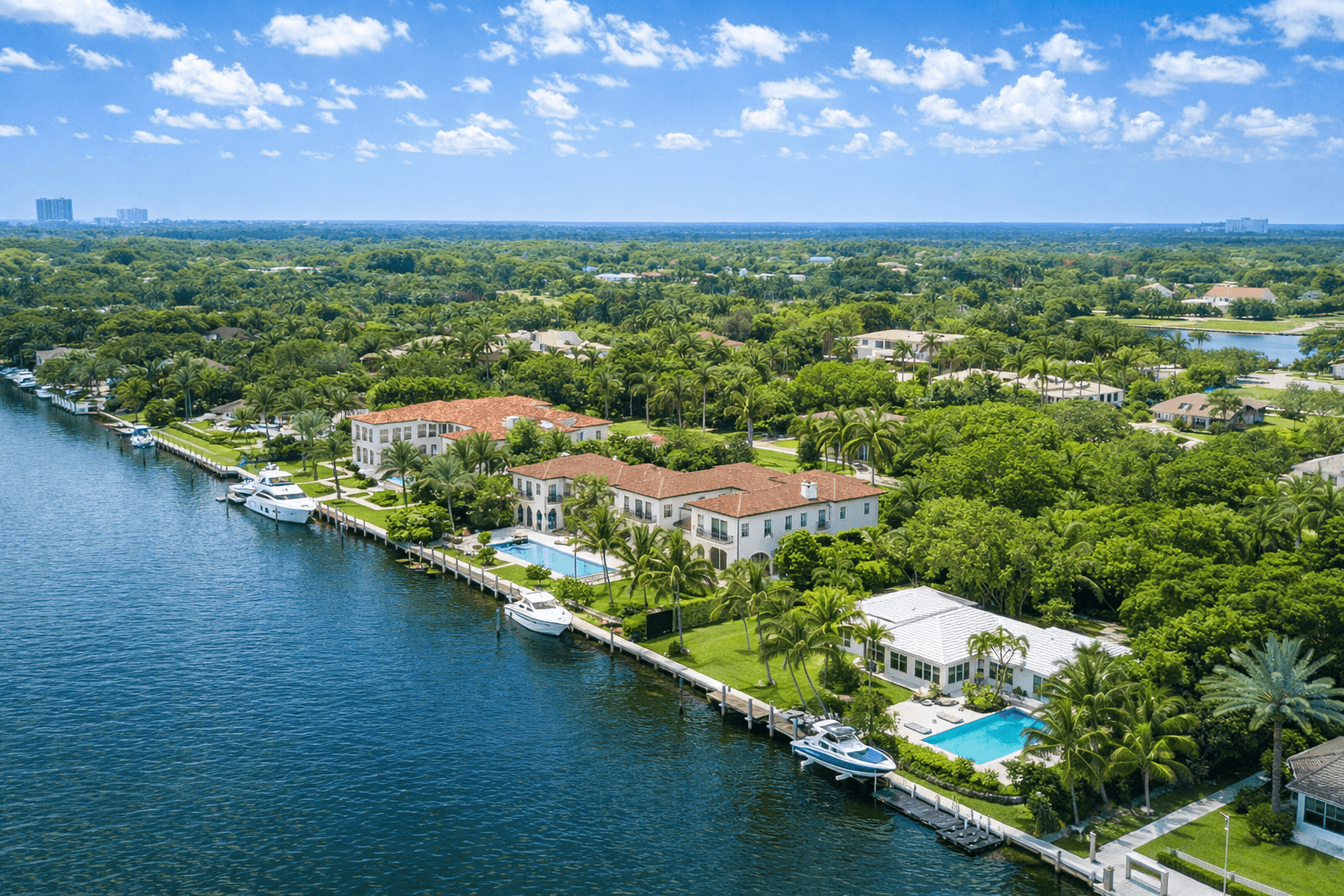
Instead of competing for finished properties, more sophisticated investors begin to operate at the origin of the product. They acquire older properties, often with little architectural relevance, simply to access the land and rebuild. This decision is not aesthetic — it is financial. It reflects a shift where the primary asset is no longer the house, but the development potential.
The thesis: value lies at the origin, not on the shelf
Most investors are still operating in the secondary market — acquiring finished assets, competing on price, and absorbing appreciation that has, in large part, already occurred. This model works in balanced markets. But it loses efficiency when supply is constrained.
When there is more capital than available product, the market stops rewarding those who buy better and starts rewarding those who build.
This is the paradigm shift.
In this context, real estate development (build-to-sell) is not just an alternative — it becomes the primary driver of value creation. It allows for early entry, control over the final product, alignment with real market demand, and, most importantly, the capture of margins that do not exist in finished assets.
More than that, it eliminates one of the biggest challenges for traditional investors: direct competition.
While most compete over the same limited inventory, developers create their own assets.
The movement that has already started — but is not yet obvious
This repositioning is already underway, but still not widely visible. A more selective group of investors has shifted from being buyers to acting as developers, even if indirectly. They understand that in a market with structural scarcity, the biggest risk is not entering — it is entering too late, when value has already been captured.
For international investors, especially Brazilians, this opportunity remains less accessible due to structural complexity, local execution, and market knowledge barriers. And that is precisely why it remains asymmetric.
The shortage of luxury homes in Florida, therefore, should not be interpreted as an isolated phenomenon within the high-end segment. It is a leading indicator of a broader issue: lack of product in a high-liquidity environment.
And where there is a lack of product, there is room for development.
This is the perspective that separates those who follow the market from those who position themselves strategically within it.
For those who understand the full cycle — from land acquisition to asset delivery — the game changes. The focus shifts from finding opportunities to structuring opportunities.
And this is where the U.S. market begins to make more sense for investors seeking not just exposure, but real participation in value creation.
If it makes sense to look at this market through this lens, it is worth understanding how this type of structure is being applied in practice — connecting investors to real estate development with curation, transparency, and local execution.
Because in the end, the advantage is not in accessing the market. It is in accessing the origin of value.
Blog